“Think gradual progression, not prescription”
Disclaimer: This article is intended for general educational purposes and should not replace individualized medical advice, assessment, or treatment. Postpartum recovery and return to exercise are highly individual. If you are experiencing symptoms, have concerns about your recovery, or are unsure how to progress your activity, seek guidance from an appropriately qualified healthcare professional.
When returning to exercise, sport or physical activity postpartum, it can be helpful to consider the four variables of FITT:
Frequency – how often?
Intensity – how hard?
Time – how long?
Type – what kind of activity or exercise?
I’ve previously written a post introducing all four FITT variables and how they can be used when thinking about exercise postpartum. If you’re new to FITT, you may want to start there for an overview.
Over the next four posts, I’ll take a closer look at each variable individually and how it may change as we move through the different stages of returning to exercise postpartum.
Although we’ll look at them separately, remember that the four variables are closely connected, changing one will often influence the others.
If you increase the intensity of an activity, you may need to reduce its frequency or duration. If you change the type of exercise, your tolerance for how often or how long you perform it may also change. The four variables continuously interact.
The pyramid provides a visual way of thinking about this progression on a group level, from gradually returning to physical activity and everyday life, through more structured exercise, and eventually towards running, sport, classes and higher-load strength training.
Importantly, the time frames in the pyramid are not set milestones or deadlines.
Postpartum recovery and return to exercise are highly individual. Where you are within this progression, and how quickly you move through it, may be influenced by many factors, including your activity during pregnancy, type of delivery, birth-related or other injuries, previous training experience, symptoms, sleep, recovery, mental health and the demands of caring for a new baby.
This individual variation is also what can make returning to exercise postpartum challenging. There isn’t one progression that will suit everyone.
Rather than viewing the pyramid as a timetable, think of it as a framework for progression, with frequency, intensity, time and type adjusted along the way according to your needs, preconditions, and goals. As in “return to exercise and sport” there is no straight line.
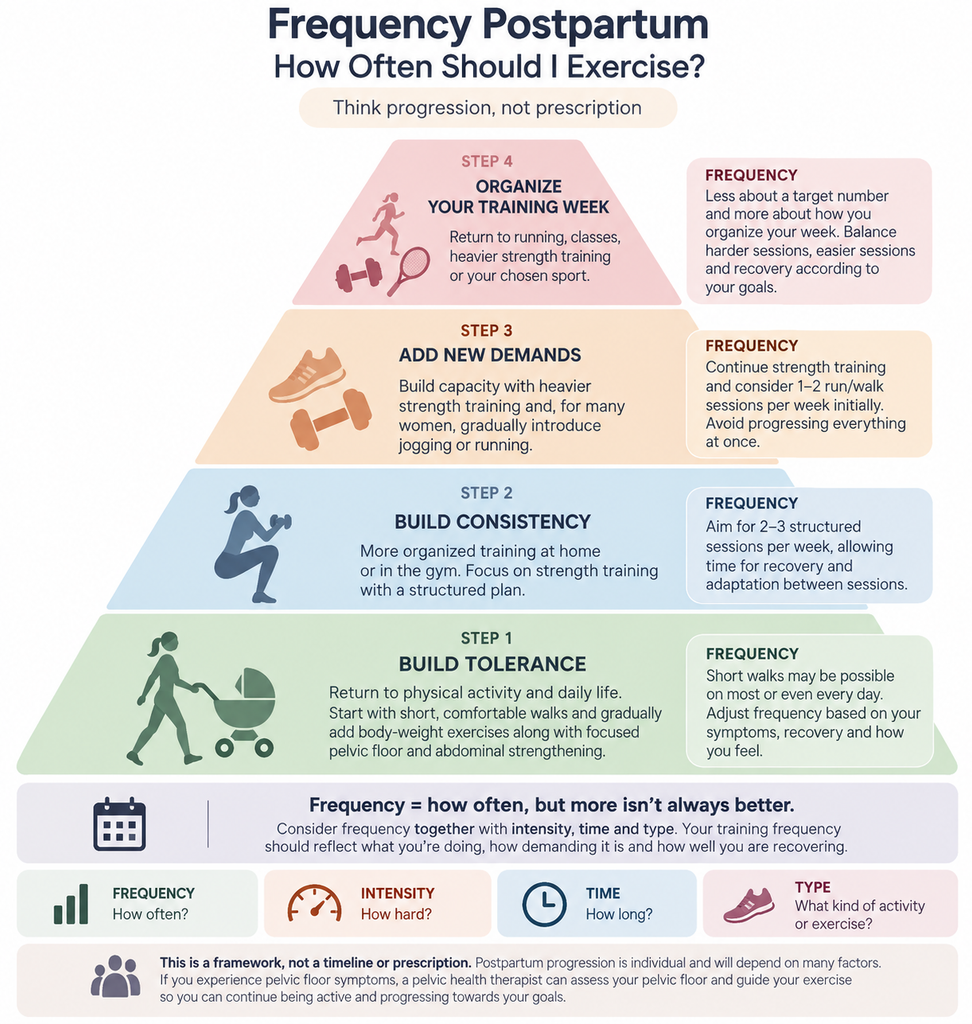
(AI generated image with my wording)
Frequency – what does it mean?
Frequency refers to how often you perform an activity, for example, how many times per week you walk, exercise or strength train.
When we talk about frequency postpartum, there isn’t necessarily one number that is right for everyone. Frequency may change depending on where you are in your recovery and should be considered alongside the other exercise variables: intensity, time and type.
Step 1 – Returning to physical activity and daily life
For many new mothers, returning to physical activity begins with short, comfortable walks, which may be possible on most or even every day. What counts as “short” or “long” is individual and will depend on your recovery, symptoms, fatigue and how you feel.
During the first six weeks, some mothers may also feel ready to introduce body-weight exercises alongside focused pelvic floor and abdominal strengthening. At this stage, think about your “pelvic floor economy” — how much activity your body can comfortably tolerate across the day and week.
If you are combining longer walks with exercise, doing both every day may be too much. You might alternate activities, shorten your walk on exercise days or include easier days.
Think of frequency as something you can adjust rather than a fixed target. Increasing pain, pelvic heaviness, leaking, excessive fatigue or other symptoms may be signs that your overall activity needs to be modified.
Step 2 – More organized training
As you begin more organized training, at home or in the gym, you may aim for 2–3 structured sessions per week, allowing time for recovery and adaptation between sessions.
As the intensity or load of your exercise increases, you may temporarily need to modify other activities. A more challenging strength session might mean a shorter walk or an easier day afterwards. Over time, as your capacity increases, everyday activities such as walking, carrying and chasing after an older child may also become easier.
Consider following a structured program that includes your exercises, sets, repetitions and load. Repeating a similar program for around 2 weeks or 4–6 sessions gives you an opportunity to adapt and observe how your body responds before progressing.
Step 3 – Building capacity and increasing intensity
As your capacity increases, you may begin lifting heavier loads and, for some women, gradually introduce jogging or running.
Adding a new activity doesn’t necessarily mean simply adding more exercise to your week. If you are strength training 2–3 times per week, for example, you might initially add 1–2 short run/walk sessions while keeping the rest of your training relatively consistent.
Try not to progress everything at once. If you increase your running frequency, you might maintain your strength-training load for a while, and vice versa.
Remember, frequency alone doesn’t tell us the whole story. Two short, easy runs create a very different training load from two long or high-intensity runs.
Step 4 – Returning to exercise, running and sport
At this stage, you may be returning to running, classes, heavier strength training or your chosen sport. Frequency now becomes less about reaching a particular number of sessions and more about how you organize your training week.
Your week might include several different activities, but they don’t all place the same demands on your body. Consider how you distribute harder and easier sessions, recovery and everyday activity.
You can gradually build towards consecutive training days, heavier loads and more demanding activities as appropriate for your goals. Returning to sport doesn’t mean progression is finished, frequency, intensity, time and type can continue to change as your capacity develops.
The takeaway
There is no magic number of sessions per week. Frequency should reflect what you are doing, how hard and how long you are doing it, and how well you are recovering.
The goal is not simply to exercise more often, but to gradually build the capacity to meet the demands of your life and the activities that matter to you.
Lastly, if you are experiencing pelvic floor symptoms, never hesitate to reach out to a pelvic health therapist. They can assess your pelvic floor and, importantly, guide and modify your exercise so that you can continue being active and progressing towards your goals.
You’ll find me and my colleagues at Hela Kvinnans Klinik in Stockholm. Book an appointment by clicking to my homepage
Leave a Reply